
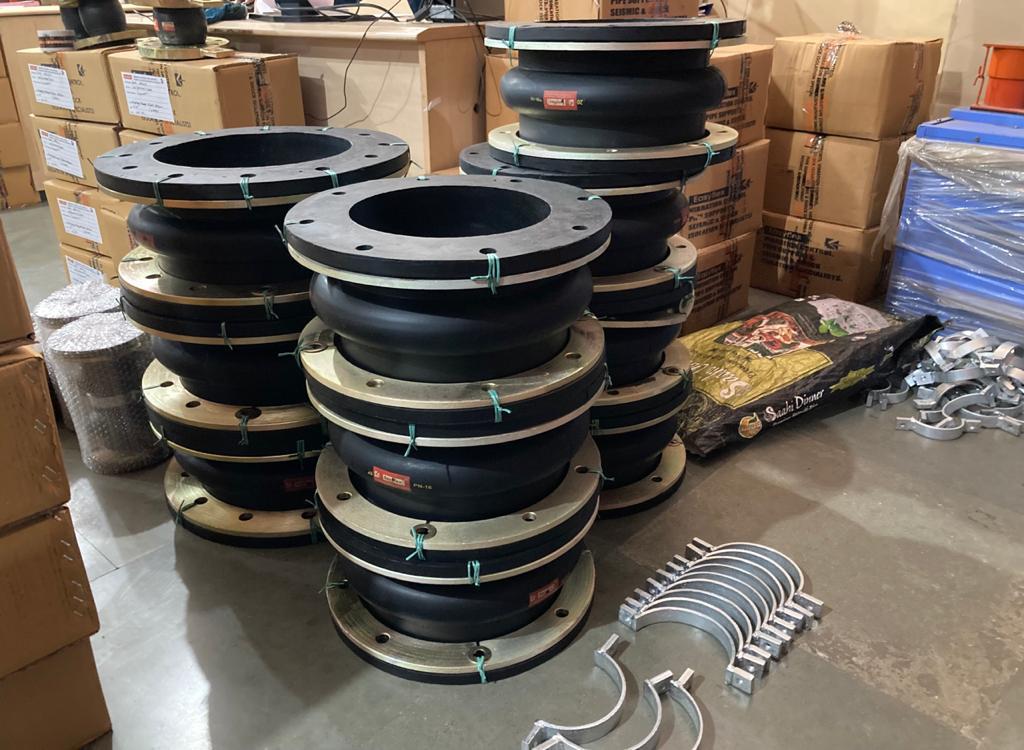
If you are specifying, procuring, or designing piping systems in India, you have almost certainly encountered rubber bellows — even if you did not know exactly what they were called. These components are critical to the performance and longevity of piping systems across industries, yet they are frequently misunderstood, under-specified, or incorrectly selected.
This guide covers everything you need to know: what rubber bellows are, the types available, the materials used, and the industries that rely on them most. It is written for consultants, procurement teams, and project engineers who need a clear, practical reference — not a catalogue.
What Is a Rubber Bellow?
A rubber bellow — also called a rubber expansion joint or flexible connector — is a flexible element combined with metal and/or textile reinforcements, used for conveying fluids and absorbing movements between sections of a pipeline. With the correct design, it absorbs axial, lateral, and angular movements while offering safety and insulation against noise and vibrations.
Unlike rigid pipe fittings, a rubber bellow is designed to flex. This flexibility is its primary function. Without it, thermal expansion, mechanical vibration, and installation misalignments are transferred directly to joints, flanges, and connected equipment — causing premature failure and costly downtime.
Simple definition: A rubber bellow is a flexible joint that protects your piping system from movement, vibration, and misalignment. It is the component that absorbs what rigid systems cannot.
Types of Rubber Bellows
Easyflex manufactures a comprehensive range of rubber expansion joints covering the widest range of applications and dimensions. Each type is designed for specific movement requirements and installation conditions. Selecting the wrong type is one of the most common — and costly — mistakes in piping design.
1. Single Arch (REJSA)
The Spool Arch type is a full face integral flange design, the most widely specified rubber expansion joint in HVAC and industrial piping. Construction is of fabric and rubber, reinforced with metal rings or wires for pressure resistance. Flanges are integral with the body and drilled to conform with the bolt pattern of the metal companion flange — the face flange is sufficient to form a tight seal without the use of a gasket.
- Best for: General purpose piping, pump connections, HVAC systems
- Movement: Axial compression and extension, lateral, angular
- Key feature: Integral flanges, fabric and rubber construction with metal reinforcement
2. Double Arch (REJDA)
The Double Arch type is a full face integral flange design featuring two arches, giving it the ability to accommodate movements greater than those a single arch joint is capable of. The length of the joint is greater than the single arch model. Suited for applications where larger movements need to be absorbed without increasing pipe stress.
- Best for: Higher movement capacity applications, longer spool requirements
- Movement: Greater axial, lateral, and angular range than single arch
- Key feature: Two-arch construction for extended movement capability
3. Wide Arch (REJWA)
The Wide Arch type features greater movements than the standard spool arch type. Full face flanges are integral to the body. Designed with a weave fabric for pressure-resisting strength, and also available in both metallic and non-metallic reinforced designs. The wide arch profile allows for higher lateral deflection in a compact overall length.
- Best for: High movement applications where space is limited
- Movement: Greater movements than standard single arch
- Key feature: Weave fabric construction, available in metallic and non-metallic reinforcement
4. Twin Sphere Connectors with Threaded Unions (EFTSCU)
The Twin Sphere Connector with Threaded Unions provides efficient noise and vibration isolation with the ability to absorb large displacement due to eccentric, axial, and angular movement. Applicable for both suction and discharge connections, the female threaded unions allow for easy installation without the need for flanged pipework.
- Best for: Pump connections, suction and discharge, small bore applications
- Movement: Eccentric, axial, angular — large displacement range
- Key feature: Female threaded unions for quick installation, suitable for both suction and discharge
5. Floating Flange Spherical Molded Single Arch (REJFF)
Designed with a long radius arch to provide additional movement, the Floating Flange type differs from standard integral flange designs in that the carcass does not contain metal reinforcements. This results in a high burst pressure capability and excellent flexibility. Generally available for pipe sizes under 20 inches.
- Best for: Smaller bore applications, systems requiring high burst pressure
- Movement: Greater axial and lateral movement due to long radius arch
- Key feature: No metal reinforcement in carcass, high burst pressure, floating flange design
Rubber Bellow Materials — What They Mean and Why They Matter
Material | Temperature Range | Best For | Avoid With |
EPDM | -40°C to +150°C | Hot/cold water, steam, HVAC | Oils, solvents |
Neoprene (CR) | -30°C to +100°C | Refrigerants, mild chemicals | Strong oxidising agents |
Nitrile (NBR) | -30°C to +100°C | Oils, fuels, hydrocarbons | Ozone, ketones |
Natural Rubber (NR) | -50°C to +70°C | Water, mild acids, sewage | Oils, ozone, UV |
Silicone | -60°C to +200°C | High temp, food, pharma | Steam at high pressure |
PTFE Lined | -200°C to +260°C | Aggressive chemicals, acids | Very high movement loads |
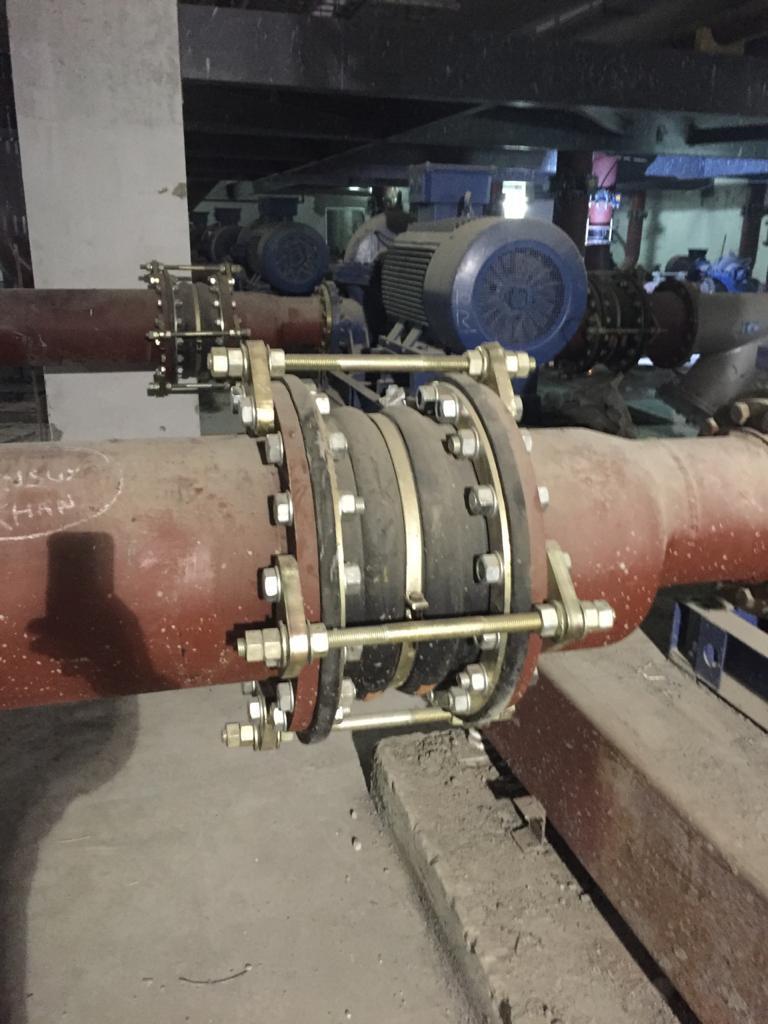
Easyflex Engineering Tip: Always specify the medium, temperature, and pressure when selecting a rubber bellow material. A bellow correct for water may fail within months when exposed to a different fluid. We review this at the specification stage — before anything is ordered.
Industries That Rely on Rubber Bellows
Rubber expansion joints are used across virtually every sector involving piping, ducting, or mechanical equipment. Here are the primary industries and their specific applications:
HVAC & Building Services
The largest application segment in India. Rubber expansion joints are installed on every chiller pump, cooling tower, AHU connection, and primary/secondary circuit throughout commercial buildings and data centres. Primary functions are vibration isolation and noise reduction.
- Pump inlet and outlet connections
- Chiller and AHU connections
- Primary and secondary circuit breaks
Water & Wastewater Treatment
Water treatment plants, pumping stations, and sewage treatment plants use rubber bellows extensively. Chemical resistance to treated water, chlorine dosing, and abrasive slurries are primary requirements. Easyflex rubber expansion joints are suited to raw and secondary sewage lines, sludge pumps, and centrifugal air blowers.
- Pump connections at treatment plants
- Sludge pump and centrifugal blower connections
- Chemical dosing line connections
Power Generation
Nuclear and fossil fuel plants use rubber expansion joints to reduce thermal expansion and contraction on condenser lines, condensate lines, steam turbine exhaust lines, aeration systems, and cooling water lines. Reliability, large size capability, and long service life are the critical requirements here.
- Cooling water and condensate system connections
- Steam turbine exhaust line connections
- Aeration system pipework
Process & Chemical Plants
Chemical plants, refineries, laboratories, and research facilities all rely on rubber expansion joints for process piping protection. The excellent chemical resistance of rubber and synthetic elastomers makes these joints ideal where corrosive chemicals, abrasive slurries, or reactive liquids and gases are being conveyed.
- Chemical transfer lines and process equipment connections
- Pump and compressor connections in aggressive media
- Centrifuge and slurry handling connections
Marine & Shipbuilding
Rubber expansion joints eliminate electrolytic corrosion while insulating against sound transmission — allowing necessary motion and flexibility in a moving ship’s piping system. Applications include auxiliary condensers, air intake on diesel engines, overboard discharge lines, and fire and bilge pumps.
- Auxiliary condenser and diesel engine air intake connections
- Overboard discharge and ventilation lines
- Fire, bilge, and sanitary system pump connections
What Makes a Quality Rubber Bellow?
Not all rubber bellows are equal. In a price-sensitive market, it is straightforward to procure bellows that look identical but fail within months. Here is what separates a quality product:
- Consistent wall thickness throughout the arch — uneven walls create stress concentrations that lead to splitting
- Correct reinforcement — fabric and metal ring or wire reinforcement embedded in the rubber to handle pressure
- Accurate movement rating — sized for the actual movement the bellow will experience, not just the bore
- Material traceability — compound used should be traceable to a known specification
- Positive sealing for leak-free operation — integral flanges that seal without gaskets
- In-house testing — the manufacturer demonstrates pressure and movement testing on their own floor
At Easyflex, our rubber bellows are tested in-house before despatch. Our engineering team designs the tooling, controls the compound, and validates the finished product — so you receive a bellow that has already proven it can do the job.
Rubber Bellows vs Metallic Bellows — A Quick Comparison
A common question at the specification stage is whether to use rubber or metallic bellows. The answer depends on the application:
Factor | Rubber Bellows | Metallic Bellows |
Temperature Range | Up to 200°C (silicone) | Up to 800°C+ |
Movement Capacity | High lateral & angular | High axial, moderate lateral |
Vibration Isolation | Excellent | Moderate |
Noise Attenuation | Excellent | Limited |
Chemical Resistance | Good (material dependent) | Excellent (SS/Inconel options) |
Cost | Lower | Higher |
Best For | HVAC, pumps, water, marine | High temp, high pressure, critical process |
Frequently Asked Questions
These are the questions our engineering team receives most often from consultants, contractors, and procurement teams.
What is the difference between a rubber bellow and a rubber expansion joint?
They refer to the same component. The term ‘rubber expansion joint’ is more common in process and infrastructure applications, while ‘rubber bellow’ is widely used in HVAC and building services. Both describe a flexible rubber connector used to absorb movement and isolate vibration in piping systems.
How long does a rubber bellow last?
A correctly specified and installed rubber bellow should last between 10 and 20 years under normal service conditions. Premature failure — typically within 2 to 5 years — is almost always the result of incorrect material selection, wrong movement rating, or improper installation. This is why the specification stage is so critical.
What information do I need to specify a rubber bellow?
At minimum: pipe bore size, flange standard and rating, medium being conveyed, operating temperature, operating pressure, type of movement required (axial, lateral, angular), and any chemical compatibility requirements. Easyflex reviews all of these at the enquiry stage to ensure the correct product is specified first time.
Do rubber expansion joints require control rods?
Control rods must be used to protect expansion joints from excessive movement if the piping system is not properly anchored, and are normally recommended for most piping installations. All Easyflex units have integrally moulded flanges and require metallic split retaining rings behind the flanges to back up and protect the rubber integral flange.
Who are the leading rubber bellows manufacturers in India?
There are manufacturers across India with concentrations in Mumbai, Pune, Chennai, and Bangalore. Easyflex is a Bangalore-based manufacturer with over 30 years of engineering and manufacturing experience in vibration, shock, and noise isolation solutions — offering in-house design, testing, and comprehensive product support.
Working on a project that needs rubber bellows?
Easyflex designs and specifies the right solution for your system — from the first enquiry to in-house tested delivery.
📩 DM us or email your project details — we get it done.
Easyflex™ | enquiries@easyflex.in | easyflex.in