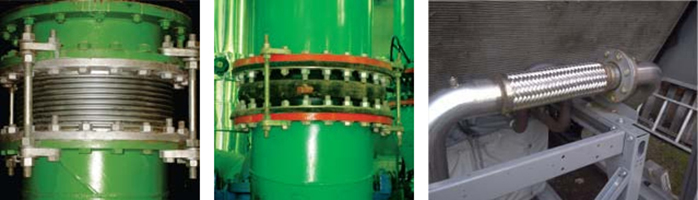
Piping systems expand and contract due to temperature changes, pressure variations, and mechanical vibrations. Without proper compensation, these movements can cause stress, leaks, or even catastrophic failure. Expansion joints are the solution — they absorb movement and protect your system.
Why Do We Need Expansion Joints?
Thermal Expansion: Pipes elongate when heated and shrink when cooled.
Vibration Isolation: Pumps and compressors transmit vibrations that can damage piping.
Misalignment Compensation: Helps correct minor installation offsets.
Types of Expansion Joints
Expansion joints come in various designs to handle different movements:
Axial Expansion Joint
Handles movement along the pipe axis (lengthwise).
Lateral Expansion Joint
Absorbs sideways movement perpendicular to the pipe axis.
Angular Expansion Joint
Accommodates bending or angular rotation.
Universal Expansion Joint
Combines axial and lateral movement capabilities.
Hinged & Gimbal Expansion Joints
Used in complex piping layouts to absorb angular movement while controlling pressure thrust.
Pressure-Balanced Expansion Joint
Ideal for systems where pressure thrust must be neutralized.
Materials & Applications
Metal Bellows: Stainless steel (304, 316, 321) for high temperature and pressure.
Rubber Expansion Joints: EPDM, Neoprene, NBR for water, HVAC, and chemical lines.
PTFE-Lined Joints: For corrosive media.
Fabric Expansion Joints: For ducts, flue gas, and turbine exhaust.
Standards & Design Guidelines
EJMA (Expansion Joint Manufacturers Association): Global design standard for bellows.
ASME B31.3 Appendix X: Piping code for expansion joint design and installation.
Installation Best Practices
Always install with proper anchors and guides.
Maintain neutral length during installation.
Remove shipping bars after installation.
Avoid torsion and over-extension.
FAQs
How do I select the right expansion joint?
Choose an expansion joint based on:
Movement type: Axial, lateral, angular, or a combination.
Operating conditions: Temperature, pressure, and media.
Material compatibility: Stainless steel for high temperature/pressure; rubber or PTFE for chemical resistance.
Standards compliance: EJMA or ASME B31.3 for design integrity. Always consult the manufacturer’s sizing guide and provide accurate system data.
What is pressure thrust and why does it matter?
Pressure thrust is the force generated by internal pressure acting on the effective area of the bellows. If not controlled, it can overload anchors and guides, causing system failure.
Solutions:
Use proper anchoring and guiding.
Consider tied or hinged expansion joints to absorb thrust.
For critical systems, use pressure-balanced designs.
EJMA vs ASME — which should I follow?
EJMA (Expansion Joint Manufacturers Association): Provides detailed design formulas for bellows, cycle life, and movement limits.
ASME B31.3 Appendix X: Covers piping code requirements for expansion joints in process systems. Recommendation: Follow EJMA for design and ASME for compliance in industrial piping projects.
Call to Action
Download our Easyflex Expansion Joint Catalogue or Request a Quote today!
An expansion joint is installed in piping systems for a couple of reasons. Not only can they be used to absorb vibrationsand shock, they can also be used to relieve anchor stress, reduce noise, and compensate for misalignment. Certain expansion joints are also designed for thermal expansion in very hot applications.
Expansion joints allow pipes to move in three different ways: • Axial compression or extension • Lateral offset • Angular deflection
They typically come in three different materials to cover a variety of applications.
Metal – Metal expansion joints are mostly used in applications where thermal expansion is an issue. When the temperature of the pipe increases, the metal expansion joint compresses to compensate for the movement, taking stress off the anchors and the pipe. A metal expansion joint is a prime example of how to handle expanding hot pipes.
Rubber – Rubber can be used for thermal expansion, and it also absorbs vibration and shock waves extremely well. That’s why this type of expansion joint is great for minimizing the transmission of noise, vibration from other equipment to protect equipment like pumps. They also work as shock absorbers to minimize trauma caused by water hammer, pressure surges, and seismic events.
Braided – Braided stainless hoses with flexible or metal liners aren’t technically an expansion joint, more of a flexible connector. They work well in high pressure and temperature applications requiring vibration dampening or pipe misalignments. These are often used on pumps and other equipment to help eliminate thrust load on the equipment nozzles due to thermal expansion. Eliminating that load is critical to pump performance. Braids provide lateral an angular movement. They also absorb vibration rather well.
Why would I need one?
We described some of the big reasons why expansion joints are helpful in piping systems already, but just to recap: • Thermal expansion of piping • Solve initial piping misalignment and settlement lateral offsets • Pump and equipment vibration • Shock and bending loads
Your entire process is intertwined, each piece affects the next. Having a reliable piping system is key to a process that maximizes uptime. Carefully managing your piping system not only keeps the pipes in great working condition, but also extends the life of the equipment attached to it. For more information, visit our website at www.easyflex.in